
The Meaning Gap
A Field Essay on AI and the New Sources of Value

I was presenting to a room of about 250 technology leaders not long ago, and I asked them a simple question. Raise your hand if AI gives you any fear or anxiety. Every hand went up. Then I told them to keep their hands up, and lower them only if they would wave a magic wand and make AI disappear.
Not one hand went down.
Think about that. A room full of senior leaders, all of them uneasy, not one of them wanting AI gone. That contradiction is the whole story.
It’s easy to assume the fear is all about the AI technology itself: smarter models, more chips, more data centers, the robots we keep being told are coming. A massive technology shift. It isn’t. The fear is about something underneath all of that, something nobody in that room had words for.
I think I have the words.
More than thirty years ago I co-founded an Internet service provider (ISP). I was building internet services before the web browser even existed. My job, mostly, was explaining to people why this thing, the Internet, mattered, and watching how they answered. The responses were as you might expect with a new and hyped technology. Some moved on it. Some waited. A few ignored it completely.
I once sat across from a Fortune 100 company that told me, to my face, that they didn’t need email or Internet connectivity. They would wait and see if the whole thing was a fad or would amount to anything before making a decision. I won’t name the company, so as not to embarrass them, and don’t worry, they did just fine. Hindsight is 20/20, as the saying goes.
I’ve been watching AI show up the same way, only faster. And here’s the part almost nobody can see.
This isn’t a technology shift. It’s a shift in meaning.
That’s what those 250 people were feeling with their hands in the air. Not fear of the technology. Fear that meaning is moving faster than they can keep up with it.
So let me start there.
What a meaning shift is
Take a cup of coffee. For most of its history it was utilitarian, a dark, bitter thing cowboys drank on the trail to stay awake. Then ask my teenage daughter what coffee is. When she says she’s going to get a coffee, she’s often not talking about the drink at all. She’s talking about the place, who she is when she is there. Half the time when she buys a drink, it’s not even coffee, just something bright and sweet. Same word, completely different meaning. The drink barely matters anymore. The meaning moved.
That’s a meaning shift. Something keeps existing, but its purpose or significance changes.
Not everything moves, though. Table salt means roughly what it meant a thousand years ago. Some things shift almost overnight, some over decades, some barely move at all. Reading that spectrum is its own discipline, and most people miss the shift while it’s happening.
When a domain shifts
Coffee and salt are small. A single product changing what it means to people. Now step up a level, because some meaning shifts are not about one product. They’re about a whole domain. And when a domain shifts, far more than a product changes with it.
I lived through one of these. The Internet didn’t arrive looking inevitable. At first, it felt like a hobbyist thing, a strange side door for the technically curious. Then it went on to reshape commerce, media, communication, how we date, how we work, and how we understand the world. Not one domain. Many.
It just happened slowly enough, over thirty years, that most people had time to adjust.
Hold onto the slowness, because it matters later.
This pattern is far older than the Internet. Older than me. Two moments stay with me, one for how long ago it happened, the other for how completely the experts misjudged it.
It’s been said that when the camera arrived in 1839, the painter Paul Delaroche declared, “From today, painting is dead.”1 You can see why someone would believe it. Before the camera, most working painters made their living capturing reality, portraits and landscapes, because a painting was the only way to freeze a face or a place in time. The camera did that better and cheaper. So painting should have died.
It didn’t.
The meaning of painting shifted, from representation to expression.
But it didn’t happen fast. It took the better part of three decades. One answer arrived in the 1870s as Impressionism, Monet and his contemporaries painting not what a scene looked like but what a moment felt like, the one thing the camera couldn’t do. A shift in meaning.
The first Impressionist show opened in 1874 in, of all places, a photographer’s studio. Painting’s future was announced inside the building of the machine that was supposed to have ended it.
And it didn’t stop there. Over the following decades that one opening kept widening, into Post-Impressionism and van Gogh, into Cubism and Picasso, into everything we now call modern art. The camera didn’t kill painting. It freed painting to mean something else.
The second moment: the people paid to predict it missed by millions of years. In 1903, powered flight went from impossible to inevitable in about twelve seconds.
What gets ignored is the mood beforehand.
The world was not sure flight was coming. It was not pure fantasy, but honest consensus sat somewhere in the fog between: maybe flight happens, maybe in a hundred years, maybe never.
And the serious people had reason to doubt. Ten weeks before the first flight at Kitty Hawk, the most credentialed expert in the country, the Secretary of the Smithsonian, launched a government-funded flying machine off the Potomac and it dropped straight into the river.
The New York Times watched that failure and ran an editorial concluding that a real flying machine might take between one and ten million years.2
Sixty-nine days later, two bicycle mechanics flew.
That is the part worth sitting with. The Times was not being careless. It reasoned carefully from the best evidence available at the time, including the very public collapse of the establishment’s best-funded attempt. And it was wrong by a factor of ten million.
Even after they flew at Kitty Hawk, the Wrights were doubted for years. The same Smithsonian whose Secretary had just dropped his machine in the Potomac refused to credit them, and kept championing its own man instead. Orville finally shipped the original Flyer to the Science Museum in London in protest. So the first airplane ever built sat in exile across the Atlantic for twenty years, kept there by the institution that should have known best.
It came home in 1948. Orville had died months earlier, without seeing it return. The machine was real the whole time. For some, the meaning took almost half a century to land.
I keep coming back to this because that fog, not knowing whether the thing in front of you is hype or history, is exactly where we are with AI. Half myth, half inevitable, just like flight in 1903. And if the rest of the story holds, the meaning will lag the machine for years, even once it’s undeniable.
Two bicycle mechanics moved flight from maybe someday to fact, and in doing so they shifted the meaning of distance, of nations, of war. The technology mattered. The meaning mattered more.
Adapt, wait, or ignore
Watching the internet play out, I saw companies do one of three things. They adapted, they waited, or they ignored it.
All three could survive, because the pace was slow. The Internet took decades to remake anything, which left time to watch, to learn, to follow someone else’s lead. The choice you made was rarely fatal by itself. What you did with the years in between mattered more than the bucket you started in.
Some adapted. That was the hardest path and the least certain. It didn’t mean bolting on a website and calling it done. It meant becoming something you were not, with no promise it would work, and the results ran from modest to enormous.
The New York Times sat at the enormous end. You would think a newspaper would be among the first casualties of the internet. Instead it stopped thinking of itself as a paper and became a digital product: news, games, cooking, a subscription business with over 12 million subscribers that has little to do with ink. You could argue a large share of those subscribers are there for the word games, not the news. The one you would have bet against thrived.
Some waited, and waiting was a real option. The market moved slowly enough that you could see what was coming and follow without being left behind. Plenty of companies waited and were fine. But waiting was never free, and a few who leaned on it too long still got caught.
Borders was one. If you’re too young to remember, it was a huge, beloved bookstore chain. They had the same information everyone else had. But for seven years, they handed their entire online business to Amazon. If you went to borders.com, it sent you to the company that would bury them.
By the time they built their own site, in 2008, it was too late. They filed for bankruptcy in February 2011, and were gone by September.
Some ignored it. That was the one bet that rarely paid. You know the Blockbuster story, but the part most people miss is that Netflix was not yet the streaming giant we know now. It was shipping DVDs through the mail. And Blockbuster still had the chance to buy it.
They were watching Netflix eat into their late-fee revenue, so they doubled down on protecting the late fee. They never saw that the late fee itself was about to be replaced by the subscription.
That is exactly why they were doomed.
Three choices, and in a slow age, room for all of them. The technology didn’t decide who thrived and who got hurt. The response did, and so did the pace.
Why this time is different
In every example so far, the shift had a home. Coffee stayed in coffee. Painting stayed in art. Flight began in transportation, and even as it reached war and nations, it did so slowly, across decades.
AI has no home. It doesn’t start in one domain. And it doesn’t wait.
Here’s why. A camera is a tool for making images. An airplane is a tool for flight. Each began by changing one domain. AI isn’t a tool for one domain. It works on the layer underneath all of them: language, reasoning, creating, deciding.
So the shift is showing up in medicine, in education, in the way we make music and film, in how countries wage war. Pick almost any field and you’ll find the same thing happening inside it. All of it, everywhere, at once.
Now, has something like this happened before? In a sense, yes. Electricity reshaped lighting, manufacturing, medicine, the home. The printing press reshaped religion, science, and politics. The Internet reshaped commerce, media, and work. Multi-domain shifts are not new.
What is new is the pace, and the fact that it will not hold still.
In my Internet days, the pace was brutally predictable. Moore’s law held: processing power doubled about every eighteen months, and Internet connectivity seemed to move right alongside it. You knew the computer you bought would feel twice as fast in a couple of years, and your connection speed would not be far behind. I could tell a customer almost to the month when their speed would double. You could plan around it. Waiting was dangerous, but it was often survivable, because the shift was happening over there, in someone else’s domain, at a rate you could see coming.
That predictability is gone. Moore’s law doesn’t describe what is happening now. The shift is everywhere at once, and the rate of change no longer holds still long enough to plan against. Which is why the cost of waiting is steeper than it has ever been.
But it goes deeper than timing. A shift this broad doesn’t stop at industries. It moves underneath them, to the rules themselves. What gets rewritten isn’t your business. It’s what counts as valuable in the first place.
The advantage that made you essential yesterday can be worth nothing tomorrow, with none of the warning you used to get. That opens a gap, between what becomes possible and what any of it means.
The Meaning Gap
That gap has a shape, and you’re already standing inside it. It’s simpler than it sounds.
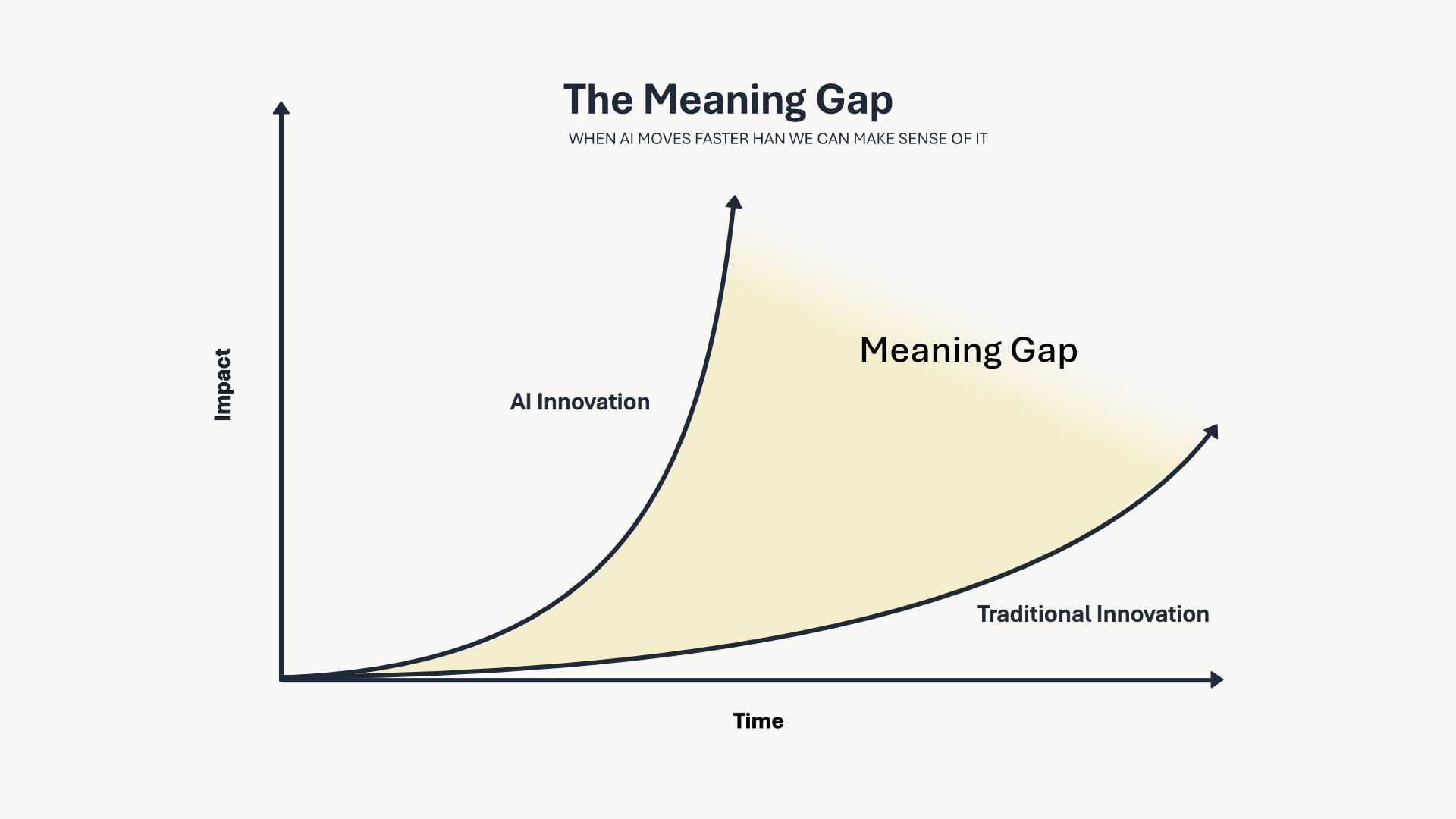
Traditional innovation climbs slowly and predictably the way it always has. That lower line is the path almost every business was built on. The AI curve is the other one. AI doesn’t just climb the same path faster. It improves so fast, and at such a scale, that it tears away from the old path and creates its own. That’s why this looks different from every shift before it. The old path bent upward gradually. This one breaks off and goes nearly vertical.
The two lines pull apart fast, and that widening space between them is what I call the Meaning Gap. It’s the growing distance between the rate at which new possibilities are being created and the rate at which we can actually make sense of them.
That gap is where everyone is living right now, whether they know it or not. And it holds two things at the same time.
It holds fear, confusion, and the kind of organizational paralysis that sets in when everyone knows something is changing, but no one knows what to do next.
But it also holds new products, new markets, and entirely new categories. Almost everything genuinely new will be born in this gap, because this is where the old rules stop working and the new ones have not been written yet.
This is the same reason those 250 leaders kept their hands up. They could feel both at once, the fear and the opportunity, sitting in the same place and refusing to cancel each other out.
The same uncertainty that paralyzes one person is where another finds the new thing. Which one it becomes for you depends on whether you can make sense of what is happening, while everyone else argues about which tool to use, which platform to adopt, and scrambles to get their agents running.
Here’s the real trap. Most people don’t know this gap exists. They cannot see the space they are standing in, so they default to the only thing they know, the old curve, the traditional way. They are not lost in the gap. They don’t know it’s there.
And you cannot take an opportunity you cannot see.
So if the environment is changing this dramatically, the real question isn’t which tool to buy. It’s what, underneath all of it, is actually changing.
The deeper shift is this: AI is splitting the economy in two. A second economy is forming, pulling away from the first, and it does not reward the same things. What is changing is not just the work. It is the source of value itself.
I’m seeing two economies
Not old companies and new companies. Two different environments for creating value, and they map onto the two lines on that chart.
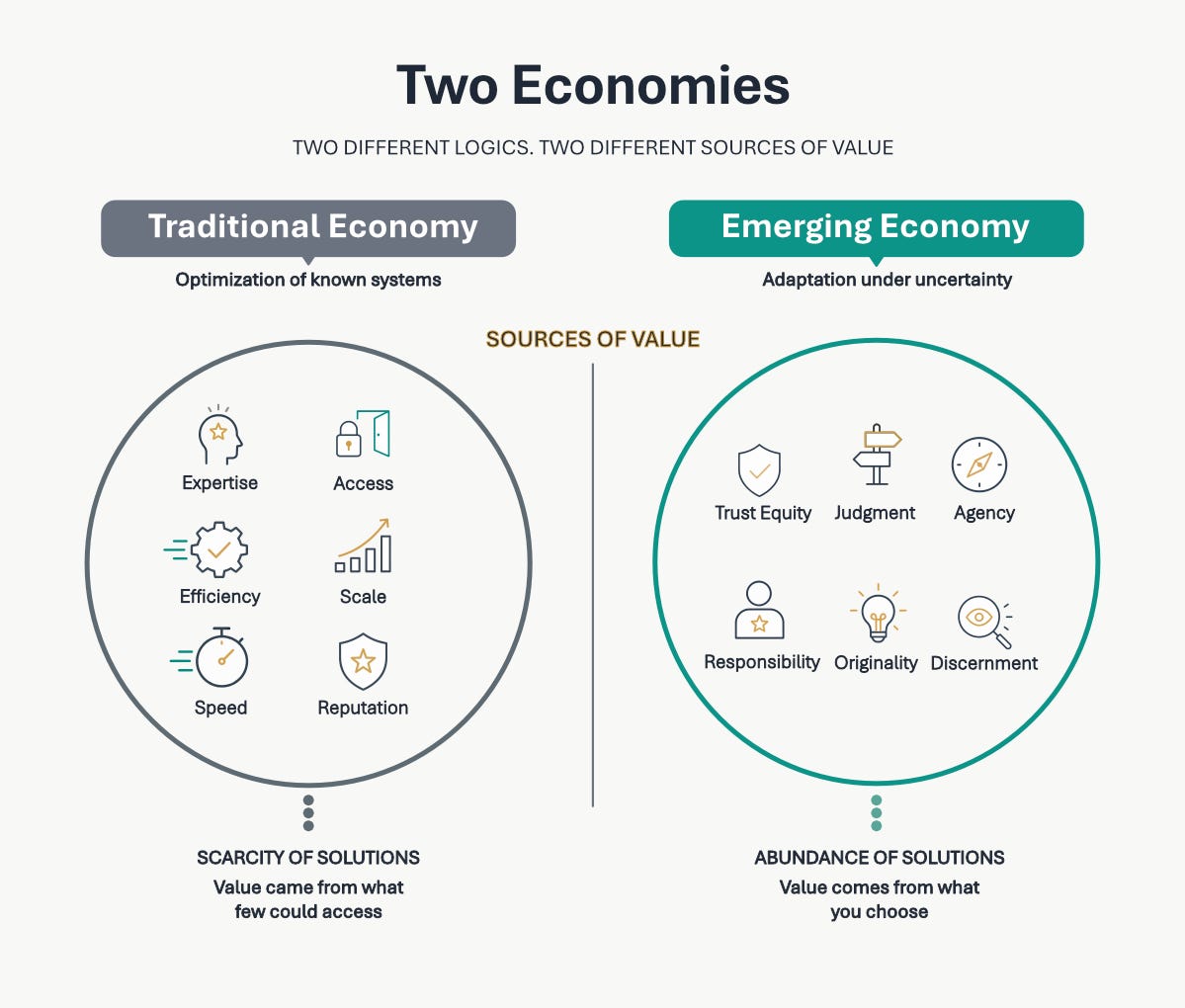
The traditional economy is the lower curve of the Meaning Gap, where traditional innovation sits. It’s an environment of relative predictability. Its job is optimization, getting better and better at things you already understand. And it runs on a scarcity of solutions, because for most of business history a good answer was hard to come by. In that economy, value came from:
Expertise. Creates authority through specialized knowledge.
Access. Creates leverage through limited entry to information, markets, capital, relationships, or distribution.
Efficiency. Creates margin by reducing waste and improving performance inside known systems.
Scale. Creates dominance through size, reach, infrastructure, and operational leverage.
Speed. Creates advantage through faster execution and response.
Reputation. Creates trust through proven performance over time.
Look closely and you’ll see most of these are execution advantages. They are about doing known things well. Look at your own organization for a second. You’ll probably recognize some, maybe all, of these as the reasons you’re still in business.
The emerging economy is the AI curve, the one going near vertical. It doesn’t run on a harder version of the old logic. It runs on the opposite logic. It’s an environment of persistent uncertainty. Its job isn’t optimization but adaptation. And instead of a scarcity of solutions, it runs on an abundance of them.
Think about what is actually true now. Anyone, regardless of expertise, with a phone or a computer and access to AI, can ask almost any question and get a dozen answers in seconds. And they all look reasonable.
The scarce thing for all of human history, a good answer, is now abundant.
We haven’t caught up. We’re still racing to find an answer. But finding an answer is no longer the hard part.
Knowing which one matters is.
In the emerging economy, value comes from a different set of sources. And I am not theorizing from a distance. I have spent my career at the intersection of two things: emerging technology and how meaning forms and transforms. The technology, I lived on the front lines of. The meaning has been my work ever since. This is the shift I am watching now: as answers become abundant, these are the sources of value beginning to rise:
Trust equity. Creates belief you can’t fake, when everyone else can generate the appearance of it instantly.
Discernment. Creates clarity out of noise, speed, and contradiction by separating what matters from what doesn’t, and catching the thing that doesn’t fit.
Judgment. Creates direction when every option looks reasonable and the answers won’t sort themselves.
Responsibility. Creates accountability and ownership of consequences when action becomes easier and faster.
Originality. Creates differentiation in a world pulled toward sameness, imitation, and commoditized output.
Agency. Creates movement and adaptive action under uncertainty.
In the emerging economy, value comes from knowing which solutions matter, who to trust, what to act on, and how to stay original when answers are everywhere.
Notice the shift. The old sources are about access to solutions. The new ones are about interpretation of solutions, about making sense of what is in front of you. There’s a name for that. Sensemaking. And it’s the whole game now. The old economy rewarded getting to the answer first. The emerging one rewards knowing which answer is worth having.
Ignore them, and here’s what happens. When a good answer is suddenly free and everywhere, everyone produces more of them. Output multiplies. Strategies converge. The same content and the same moves pile up everywhere you look. That is the noise, a rising wall of sameness that everyone keeps adding to.
And in a flood like that, the rare thing is no longer another answer. It’s the judgment to see which one matters, the trust to know who is worth listening to, and the originality to make something that isn’t just more of the same. The louder the noise, the more those are worth.
The old advantages don’t die. They turn dangerous.
The old sources of value don’t disappear. Expertise, access, efficiency, scale, speed, reputation all still matter. In some businesses, where the moat is a factory, a regulatory approval, or a balance sheet, they matter enormously, and AI barely touches them, at least for now.
But for most of them, AI is quietly thinning the advantage. The things that used to set you apart are becoming things anyone can do. And if you don’t see that the source of value has shifted, you keep running the old plays out of habit. That is where the danger lives.
Start with the obvious version. AI is collapsing the value of skills. Call it skill collapse. Things that used to take training and talent are now a sentence away.
I felt this one myself. I used to build websites. When I started, you built a website by hand, coding every line yourself. Then the bar kept rising. Better-looking sites demanded new skills, and then more skills on top of those, CSS, design tools, platforms like WordPress. Staying valuable meant never stopping, always learning the next layer. I climbed that ladder for years, and the climbing never ended.
Then one afternoon I described what I wanted to an AI, out loud, in my microphone. It built the site. And every rung of that ladder was worthless at once.
But skill collapse is the surface story. The deeper problem is subtler than “your skills are obsolete.” It’s running your old advantages as if you’re still optimizing, when you have actually moved into a world that rewards adaptation. The old economy rewarded organizations for getting better at what they already knew. The emerging one rewards organizations for adapting to what they don’t yet understand.
Run the old playbook in the new economy, and your strengths quietly turn into liabilities.
Watch what each one becomes:
Expertise becomes expert blindness. You’re so sure you know that you stop seeing what changed.
Access becomes overload. The thing that was scarce is now drowning you.
Efficiency becomes optimizing what no longer matters. You get very good at the wrong work.
Scale becomes slop at scale. You produce more of the same, faster.
Speed becomes reckless acceleration. You move fast in a direction you never stopped to question.
Reputation becomes erosion, the moment your output starts to feel generic or synthetic.
The trap is that it feels like winning. But an advantage only counts when others don’t have it. When everyone runs the same tools at the same speed, speed stops setting you apart. You’re not pulling ahead. You’re racing, faster than ever, toward the exact place everyone else is going.
If every firm uses the same AI to think faster inside the same assumptions, the whole field just accelerates toward sameness. Nobody moved.
AI doesn’t just make you faster. It makes you faster at becoming exactly like everyone else. That’s the sameness, multiplying.
You’re going to start seeing it everywhere now, if you’re not already. Look at the state of content right now. The generic post. The good-enough ad. The image that can only be AI. The thing that could have been written by anything, and most likely was. Once you see it, you cannot unsee it. The goal is simple. Notice it, and don’t be one of them.
And the best way to not be one of them is to do the one thing AI cannot do for you.
Make sense of it yourself.
So how do you make sense of this?
That’s the real question. How do you make sense of an economy where uncertainty is the rule, adaptation is the goal, and answers are everywhere? Almost no one is asking that, because almost no one can see the gap they are standing in. But you can see it now. Which means you can finally ask the question that actually matters.
This is where sensemaking actually does its work. It’s how you find clarity in the gap, how you turn overwhelming possibility into a direction you can move on, without surrendering your thinking to it.
If AI makes everything faster, cheaper, and easier to copy, then the scarce thing, the thing worth protecting, is how your mind works, your thinking, your judgment, your responsibility. These must be protected.
And here’s what struck me. This economy is genuinely new, new enough that we don’t yet know what we don’t know. Remember, the whole job of the traditional economy is to remove uncertainty. Entire organizations were built to squeeze it out, because less uncertainty meant less risk, and less risk meant predictable profit.
The emerging economy asks for the opposite. You don’t remove the uncertainty. You accept it, and you learn to work inside it. That is a hard turn for anyone whose instincts were trained on the old goal.
And we don’t have a system to think with AI. We have plenty of ways to think well. Critical thinking, the Socratic method, and a dozen others. Every one of them was built for a person thinking alone. None was built for this. Nobody handed you a system designed to work with artificial intelligence, an actual partnership between how you think and what the machine can do. That is what I mean by a system to think. Not thinking in general. Thinking with AI in the room.
We already understand a small version of this: designing your environment to think. One person needs a clean desk before they can study. Another can only do deep work in a library. I know an executive who does their best thinking in a coffee shop, and it’s so important to them that they sometimes play coffee-shop sounds in the background when they have to work from home. The room changes how they think. You do this too, you just don’t have a name for it yet.
But now the room is not just physical. AI has entered the thinking space too.
The emerging economy doesn’t ask for this kind of design. It demands it. And it demands something most people have never built, or even realized they need: not a physical space you sit in, but a mental one. A system for how your mind works alongside the machine. We have never needed one built for this before. A way to protect how we think, judge, and take responsibility with AI in the room.
I didn’t set out to build one. I just kept getting lost. I run most of my day through AI, and at one point I had ten or more tabs open at the office, a few chats running on my phone, another handful going at home, different tools, different platforms, all of it half finished. My thinking was completely scattered. And one day I lost something. A real idea, one I didn’t want to lose, gone somewhere in all those open windows. That bugged me more than it should have. So I built myself a system, with rules, so that what mattered could not slip away again. At some point it stopped being a personal fix. This was not just my problem. It’s everyone’s, and it scales, from one person to a whole organization. I call it a sensemaking architecture.
Before I show you what is inside it, the stakes. If you don’t build some version of this, you don’t just stay slow. You hand your thinking over to the machine by default. You hit a hard question, you drop it into the AI, you take what comes back, you move on.
That’s surrender. I call it cognitive surrender, and enough of it leaves you with disposable thinking, thought you never really had and would not miss.
And here’s the sting. Cognitive surrender is how your own thinking gets commoditized. You become the generic post. You become the stock AI image. You are that voice that sounds like everyone else’s. The sameness doesn’t stop at what you make. It comes for how you think, how you judge, and what you are willing to stand behind.
That is why the answer is not just to use AI better. It is to protect the spaces where your thinking, judgment, and responsibility happen.
The full sensemaking architecture is bigger than I can unpack here. It is part framework, part practice, part operating system for thinking with AI. But the high-level structure matters, because once you see it, you can feel when the machine is collapsing it.
At the center are three spaces.
The Sensemaking Architecture
The sensemaking architecture has three spaces. They have to stay separate, and each one has to be protected, because AI makes it easy to collapse them into one. And increasingly, the tools don’t just make it easy. They do the collapsing for you, by default, and call it a feature.
You don’t protect the emerging economy’s sources of value (trust equity, originality, discernment, and the rest) directly. You protect the three spaces, and those capacities emerge from them.
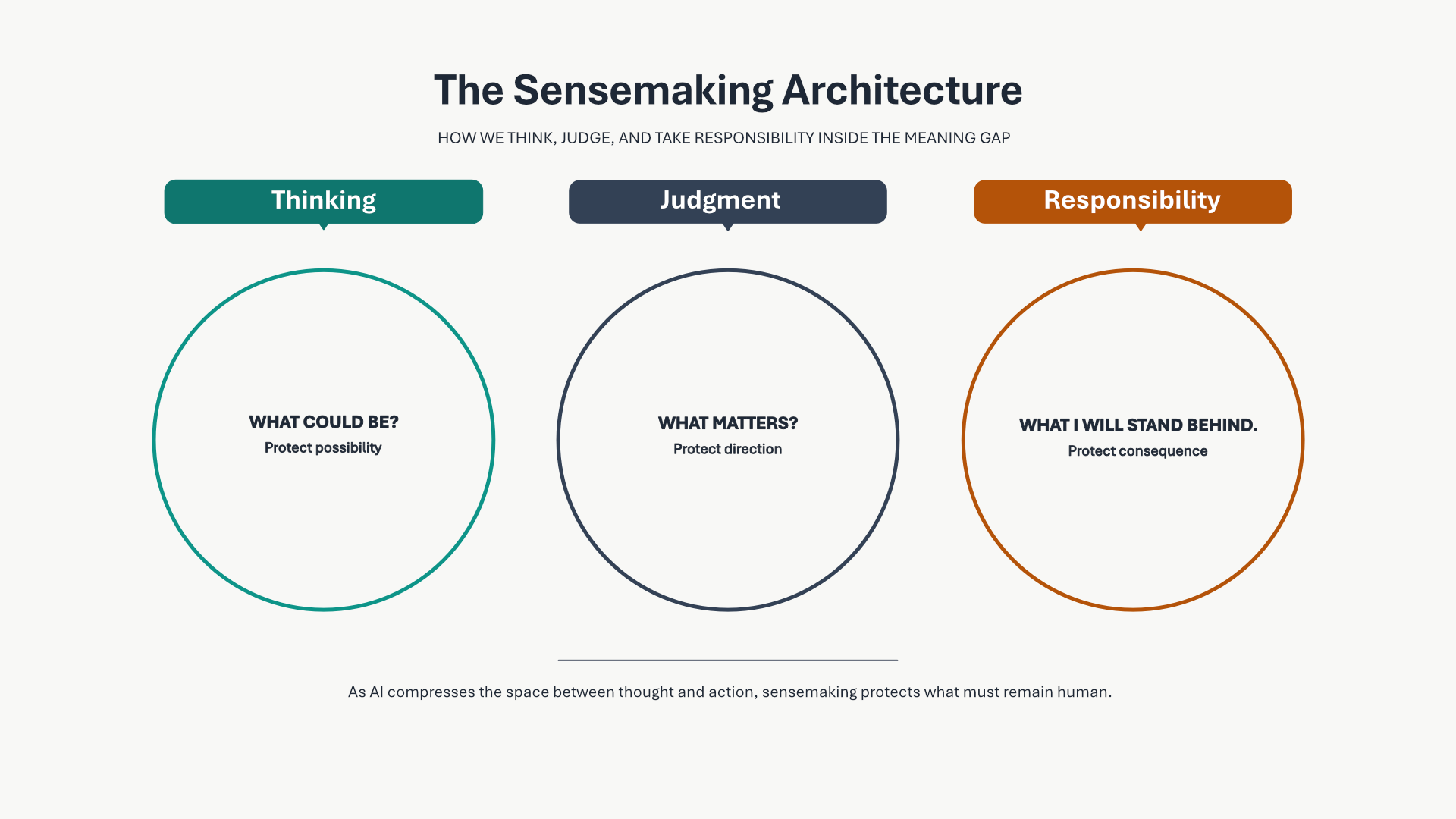
Thinking is the space of what could be. You expand, explore, test, play, and let new possibilities show up.
Judgment is the space of what matters. You interpret the options, weigh them against each other, and decide what deserves your attention.
Responsibility is the space of what you will stand behind. You commit, own the outcome, and accept the consequences.
When these three collapse into one, AI doesn’t just make you faster. It makes you thinner. You stop imagining, you stop discerning, you stop owning. And thinner is just another word for the same as everyone else.
None of this is new. It’s how good decisions have always been made. We just never drew the lines around the three. Picture a thirty-person company in the traditional economy, when solutions were scarce. A customer has an issue and asks for something nobody has built. Three people huddle and work out an approach. That is the thinking space. They bring it to a manager who weighs it and decides it’s worth doing. That is judgment. The manager takes it to the owner, who says yes, we will build it, support it, stand behind it, offer it to others. That’s responsibility. Three spaces, three roles in sequence. The structure was always there.
That is the architecture at the scale of a company, three people, three roles, three spaces. But it works the same way inside one person. The spaces don’t need three people. They need to stay separate.
Now watch it collapse. I recently overheard someone whose colleague was stuck on how to answer an email. Their advice: “I don’t know, just drop it in ChatGPT and paste the answer in.” Thinking, judgment, responsibility, all three folded into one reflex. See the tool, use the tool, ship it.
That is cognitive surrender in one sentence.
And once you see it, you start seeing it everywhere. A meeting gets summarized, but no one asks what actually changed. A strategy prompt produces five reasonable options, and the team picks the prettiest one. A buyer sends a vendor a list of AI-generated questions that sound sophisticated, but they don’t know why they are asking them, what answer would matter, or what decision the answer is supposed to change.
And it does not only happen to companies. It happens to you, quietly, one space at a time, and each one fails differently.
When your thinking space collapses, you lose possibility. You stop asking what could be and just take the first answer the AI gives you.
When your judgment space collapses, you lose discernment. Everything sounds reasonable, so nothing gets weighed. Ask for more ideas and they all seem fine, which is exactly the problem.
When your responsibility space collapses, you lose ownership. You let the system decide, and when it breaks you already have your answer ready: not my fault, it was the AI.
This is the Meaning Gap arriving at the scale of a single person. The same sameness that floods the market floods you the moment you let the machine do the thinking.
It doesn’t feel like surrender. It feels like efficiency. You take the first answer because it’s good enough, then you do it again, and again, until the part of you that used to push past the first answer quietly stops firing. That is the quiet damage. Not that AI thinks for you, but that you stop noticing when you have stopped thinking.
So the question becomes practical: what do you actually do?
The full system is more than I can hand you here. But I can put one tool in your hands now, simple enough to use immediately, strong enough to protect the first space where surrender usually begins: your thinking space. It’s a first move, not the whole system, but enough to show what protected thinking feels like.
One tool: 3 Out, 3 Wide, 3 Deep
This is how you protect the thinking space.
The rule behind it is simple.
The first answer is not the answer. The first answer is the starting point.
Skip this, and you slide straight back into the sameness. You ask one question, take the first answer, ship it, and what you ship is what everyone else with the same tool could have shipped. Volume goes up. Sameness goes up. And you mistake speed for progress.
So before you accept what the AI hands you, or what you came up with first, run the idea through three moves.
3 Out is expansion. It moves the idea in three different directions before you let it settle.
Functional. What does this need to do?
Human. What should this help someone feel or become? Most people never ask this one.
Strategic. How should this create value, or how should it be positioned?
This keeps possibility open before the machine narrows it for you.
3 Wide is perspective. Not more opinions. Better lenses. It asks you to see the idea through three lenses you would not naturally use.
User. Who is this for, and how do they actually see it?
Skeptic. Who would doubt this, resist it, or see the risk you’re missing?
Wild. Who or what would see this in a way you never could?
This forces the idea outside your own frame before you decide.
3 Deep is depth. It pushes the idea down one level at a time, because only by getting underneath the surface do you find what actually matters.
Surface. The obvious answer, the one you already have.
Deeper truth. What is really going on underneath it.
Meaning. Why it matters, and what that changes about what you should do.
Most of the real insight lives below the first answer. This is what pulls it up.
Here is what it looks like. Before we go through it, think of the last time you used AI for something that actually mattered. A plan, a message, a decision you needed help thinking through. Hold that in your head as we go.
Say you need a plan to win back a customer who’s drifting. You ask AI. It gives you a clean, reasonable plan: reach out, offer a discount, schedule a check-in. It looks fine. Most people stop here. They take the plan, run it, and it performs about as well as the same plan everyone else pulled from the same tool.
Now run it through the three moves.
3 Out, and the discount is only the functional direction. The human direction asks you to sit with what this customer actually feels, maybe they don’t want a discount, they want to feel remembered. The strategic direction asks whether this account even matters, or whether it’s telling you something about the whole segment.
3 Wide, and the plan looks different through the skeptic’s lens: a discount might read as desperation and cheapen you. Through the customer’s own lens, a call after months of silence looks like a sales move, not care.
3 Deep, and the surface answer was “stop them leaving.” Underneath is why they drifted in the first place. And under that, whether the relationship was ever built on anything but price. That is not a sharper version of the same problem. It is a different problem, with a different answer. One tells you to chase the customer. The other tells you the chase might be the mistake.
Read that and you’ll nod. Run it and something changes.
That’s the whole point. This tool does nothing on the page. Its value shows up only when you take a real decision, one you actually care about, and push it through the three moves yourself. The first answer you were about to accept, the plan you were about to run, the message you were about to send: put it through 3 Out, 3 Wide, 3 Deep before you commit to it. What comes back won’t be the AI’s answer. It’ll be yours, and you’ll feel the difference, because you stayed in the thinking instead of handing it off.
That feeling, when the obvious answer cracks open and the real one shows up underneath, is what protecting a space feels like. It’s one move, in one space. There are others, for judgment and for responsibility, and for how the three hold together across a whole team. That’s the deeper work.
But you don’t need the whole system to start. You need one protected space and one real decision. Try it this week, on something that matters. You’ll understand the rest from the inside.
Where this leaves us
We are not living through a technology shift. It isn’t about the fastest tool or the better prompt or more processing power. Those matter, but they are not the point. We are living through a shift in meaning, many shifts at once, across nearly every domain, at a pace that no longer holds still. That is the Meaning Gap. It holds fear and it holds opportunity, and which one you get depends on whether you can make sense of things while everyone else chases the next tool.
The old sources of value are being compressed. The new ones, trust, discernment, judgment, originality, responsibility, agency, are not capacities you buy. They are capacities you protect. And protecting them, deliberately, with a system, is what making sense of this actually requires. That is the work of the next several years.
You might wonder if I actually live in this, or just talk about it. I built my own sensemaking architecture, three spaces, shaped around how I think. A protected place to think, where there’s no such thing as a bad idea. A separate place for judgment, with one hard rule: what I cannot afford to lose goes there, and has to earn its way in. And a place for what I will stand behind, where the things I have committed to live in full, like this essay.
The part that still surprises me is the bridge between the first two. I built an agent whose only job is to move an idea from my thinking space into my judgment space. And it doesn’t flatter me. It pushes back, hard. It tells me when an idea isn’t ready. Sometimes I get genuinely angry, because I thought I had everything figured out, and now I have to go back and do the work again.
That anger is how I know it’s working. A real thinking system isn’t the one that agrees with you. It’s the one that refuses to let you off easy. That friction, the part that makes you want to argue with your own tools, is the sound of your judgment staying alive while everyone else surrenders theirs.
The point was never my system. It’s that you build your own.

For centuries, progress was measured by what we built. Today, it’s increasingly measured by how we adapt. As I developed these ideas, I found myself reflecting on my Latvian roots and a line from the great Latvian poet Rainis that has endured for more than a century, written for a nation finding itself:
“He who changes will endure.”
Pastāvēs, kas pārvērtīsies.
I don’t believe he was speaking only about nations or societies. He was speaking about people. Endurance isn’t found in resisting change, but in transforming ourselves to meet it.
That may be the real challenge. Not whether machines will become more intelligent, but whether we will become more thoughtful, more discerning, and more responsible alongside them.
Biography
Arthur Zards was building the internet before the web browser existed. Now he helps leaders and organizations make sense of AI, and build their own sensemaking architecture for what comes next. Keynotes and workshops. Reach him at zards@labz.io or labz.io.
© 2026 Lab Z, Inc
The essay ends here. The conversation continues.
Join others exploring the Meaning Gap, AI, sensemaking, and the human work that comes next.

The quote is undocumented and widely regarded as apocryphal. It's traditionally attributed to Delaroche on first seeing the daguerreotype around 1839, though its earliest traceable source is a 1959 study of Daguerre. Delaroche himself praised photography and continued painting until his death in 1856.
New York Times editorial, "Flying Machines Which Do Not Fly," October 9, 1903, published two days after Samuel Langley's government-funded Aerodrome failed on the Potomac. It predicted a working flying machine might take one million to ten million years to develop. The Wright brothers flew sixty-nine days later, on December 17, 1903. Verifiable through the Times' own TimesMachine archive.